Vignesh June 7, 2026
It's one of the most common money questions, and the honest answer is the one nobody likes: it depends on your numbers. Not on a rule of thumb, not on what worked for someone on a podcast, on the actual rate of your debt, the return you can realistically expect, your timeline, and whether the plan holds together month to month.
That sounds like a dodge. It isn't. The reason “it depends” is the right answer is that the decision is a math problem with a small number of inputs, and once you put your inputs in, the math is clear. The trouble is that most tools either give you a generic rule or hand you a calculator and walk away. The decision deserves better than either.
Here's the framework, and then a worked example with real figures.
The question underneath the question
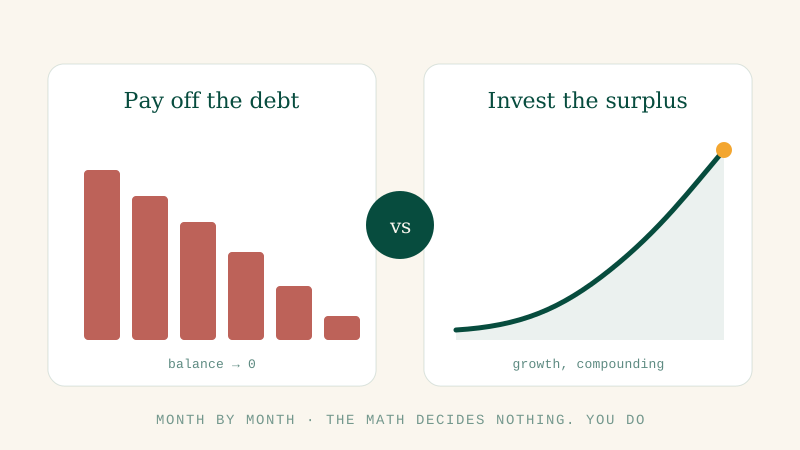
Paying off debt gives you a guaranteed return equal to the interest rate you stop paying. Clear a loan at 6.5%, and you've effectively “earned” 6.5%, risk-free, after tax in most cases. Investing gives you an expected return that is higher over long horizons but uncertain, and taxed differently.
So the first cut is simple: compare the debt's rate to the after-tax return you can reasonably expect from investing over the same period. If the debt rate is clearly higher, paying it down usually wins. If your expected return is clearly higher, investing usually wins. The interesting cases, most real ones, sit close enough that the rule of thumb stops being enough.
The break-even rule, and why it isn't the whole story
The break-even is where the guaranteed return from paying down the debt equals the expected return from investing. Above it, invest; below it, pay down. If that were the entire problem, you wouldn't need a tool.
Three things break the clean rule:
Risk isn't free. The debt payoff return is certain. The investing return is an average across good and bad paths. Two strategies with the same expected value are not equally comfortable if one can swing hard against you in a bad decade.
Taxes change the comparison. Tax-advantaged contributions, the deductibility of some interest, and how gains are taxed all move the real, after-tax numbers, sometimes enough to flip the answer.
Feasibility comes first.A plan that's mathematically “optimal” on paper but can't actually be run month to month isn't optimal. The plan has to stay feasible on the numbers you entered. A plan that only works if nothing goes wrong isn't a plan you can hold.
A good answer weighs all four (rate, risk, taxes, feasibility) for your specific situation. That's the part a generic rule can't do.
A worked example
Take a real scenario. Someone arrives with a $24,000 student loan at 6.5% and $400 a month to deploy. The question: invest alongside repayment, or clear the debt first?
Here's the part that matters, and it's the part most comparisons get wrong: both paths have to be given the same money.
It sounds obvious. It usually isn't done. The common way to compare these strategies is to model “clear the debt first, then invest” against “invest alongside repayment”, and then quietly forget that once the debt is cleared, the payment you were making is freed up. If that freed payment isn't redeployed in the model, the debt-first path is being run on less money than the other one, and the comparison is measuring the shortfall, not the strategy.
Fix that, and the interesting question stops being “which strategy wins” and becomes “what actually moves my number.” On this person's inputs, the lever is visible and specific: putting an extra $200 a month against the loan clears it by month 34 instead of month 41, and cuts roughly $3,100 of interest.That's not a rule of thumb. That's their loan, their rate, their surplus, arithmetic.
Which reframes the whole decision, from “which side am I on” to “here's what the gap costs, and here's the lever that moves it.”
The math answers the question. The person makes the call. That separation is deliberate, and it's the whole design philosophy behind InvestEd.
Why a chatbot gets this wrong
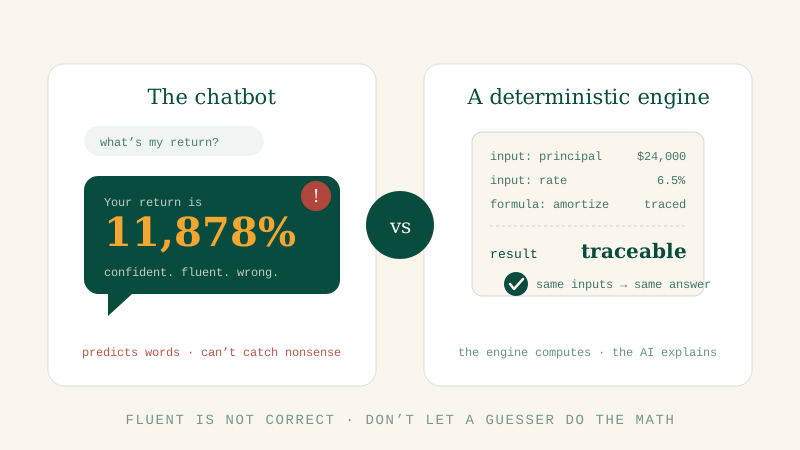
Ask a general-purpose AI the same question and it will give you a confident, fluent answer, and possibly a wrong number. Language models predict the next word; they don't run your amortization schedule and check it. For a decision that hinges on a precise figure over fifteen years, fluent and correct are not the same thing.
We tested it. We asked four leading AI assistants one simple question: the difference in final value between investing $200 a month for twenty years at 7% versus 6%. There is exactly one right answer: $11,777. The four answers ranged from $11,700 to $12,526, an $826 spread on a question with a single correct number, and not one of them showed a calculation you could check. On the judgment calls, like paying down a mortgage versus investing, they split down the middle on identical inputs.
I wrote about this at length in AI Financial Guidance: 4 Hard Truths Apps Ignore, the short version is that the fix isn't a smarter chatbot, it's putting the math first and letting the AI explain it, with its numbers checked against the engine. More on how that works on our Responsible AI page, and on why chatbots get money questions wrong in our companion piece, can you trust AI with your money?
How the popular tools compare
Search “pay off debt or invest” and you get two kinds of tool: a bank's single-input calculator, or a chatbot. Here's what each actually does with the question, judged on the only things that matter for a decision this size: can you trust the answer, and can you check it?
| Shows the math? | Re-runnable? | Handles taxes & feasibility? | Flags when the answer changes? | |
|---|---|---|---|---|
| Bank calculator | Rarely: one number out | Yes, but the inputs are shallow | No | No |
| AI chatbot | No, a confident sentence | No, answers drift ($826 spread above) | Sometimes, unreliably | No |
| A deterministic engine | Yes, every number traces to a formula | Yes, same inputs, same answer | Yes | That's the design goal |
That last column is where a decision tool earns its keep: a rate move or a policy change (student-loan repayment rules, say) can flip your answer, and most tools never tell you. The point of showing the math is that you can re-run it when your numbers change.
Run it on your own numbers
The example above is one person's situation. Yours has different inputs: a different rate, a different surplus, a different timeline and goal. The framework only becomes an answer when it's your numbers in it.
That's what the InvestEd Wealth Planner does: you enter your loan, your monthly capacity, and your goal, and it computes the month-by-month outcome of each path and shows you the break-even, and you can start a scenario in about two minutes, no account linking, no card. Every number traces back to a formula and an input you supplied, so you can see why the answer is what it is.
The honest caveat
One thing worth saying plainly: the answer depends on assumptions, especially the expected return. Change the growth assumption a little and the “optimal” split can move more than you'd expect. Treat the output as “given these assumptions,” stress-test the ones you're unsure of, and don't mistake a precise number for a certain one. A good decision tool shows you the number and how sensitive it is, false precision is the real failure mode here.
The bottom line
Should you pay off debt or invest? Compare the rate to your expected after-tax return, weigh the risk, check that the plan stays feasible with a buffer, then decide. It's your call to make. The job of a good tool isn't to make it for you; it's to show you the math clearly enough that you can.
FAQ
Is it ever better to invest than to pay off debt?
Yes, when your expected after-tax return is clearly higher than the debt's interest rate over your timeline, and your plan stays feasible. How close the two come depends on the spread between your rate and your expected return, and the closer they are, the more the answer turns on what you actually do with the money you free up.
What debt should I always pay off first?
High-rate debt (e.g., credit cards) almost always beats investing, because few investments reliably out-earn those rates after tax and risk.
Does this article tell me what to do?
No. It shows you the framework and the math. The decision is yours. InvestEd is education-first: it computes and explains; it doesn't advise.
Should I pay off my mortgage or invest?
Same framework: compare your mortgage rate to the after-tax return you can realistically expect over your timeline, then weigh the risk and whether the plan stays feasible. A rate close to your expected return is the hard case. There the answer turns on your risk tolerance and what you'd actually do with the freed-up cash, which is exactly what a generic rule can't settle for you.
Can I trust ChatGPT to decide this for me?
Use it to understand the trade-off, not to compute it. In our test, four leading assistants disagreed on the same money question and none showed math you could check. Treat a chatbot as an explainer, and run the actual numbers in a tool that shows its work.
Vignesh Coumarane is the founder and product architect of InvestEd. A data analytics professional and LinkedIn Top Voice for data, he writes about the architecture of trustworthy financial tools, including AI Financial Guidance: 4 Hard Truths Apps Ignore on Fintechbits.