
Vignesh August 14, 2026
This month another wave of “should you trust AI with your money” coverage landed: NPR ran it on August 12, on the back of a JD Power survey finding 40% of people used AI for money in the last three months. The usual takeaway is “be careful, it can be wrong.” I think trust is the wrong axis to argue about.
I build with AI every day, so let me say the pro-AI part first, because it is true. The MIT economist behind the largest study on this, Taha Choukhmane, put it plainly in that same piece: it “gets a lot of things right.” It nudges people to save more, to participate in the market, to de-risk as they age. The model is not the problem.
Watch where it actually breaks
In the same article, a financial planner asked an assistant about business structure. It confidently said S-corporation. She gave it more information; it “completely changed tunes” and said LLC. Nothing about the model got smarter in the thirty seconds between those two answers. It answered a question it did not have enough information to answer, and it did not ask for the piece that flipped it.
Here is the careful version, because the naive one is wrong: asking good questions is the model's home turf. It will interview you warmly and competently. The failure is one layer down. It does not ask the single variable that changes the answer, and it never checks whether what you told it is even possible.
A test you can run in under a minute
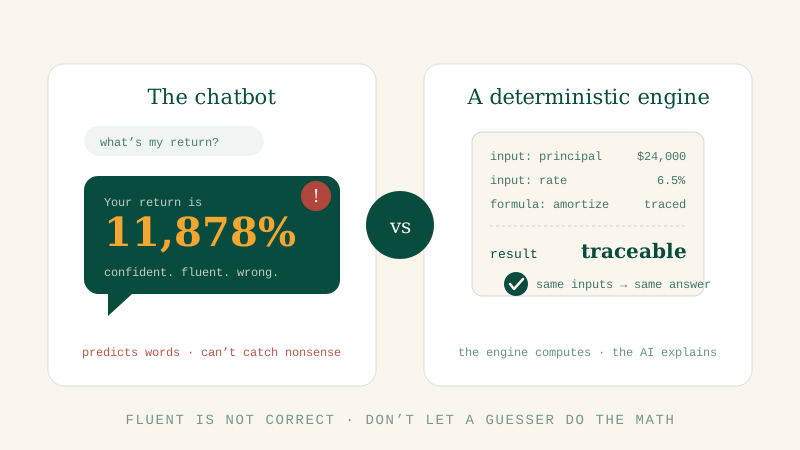
Tell an assistant you earn $120,000 in Massachusetts and can put $4,500 a month toward a plan. It will build you the plan. But $120,000 gross in Massachusetts is roughly $7,100 a month take-home. After rent, food, and a car, $4,500 of spare cash is not real, and the model plans on it anyway, because “can you actually afford this” was never one of its questions. A deterministic engine does that check first, and returns a plain answer: not feasible. That is a number you can audit, not a vibe you have to trust.
The part that should bother us
Choukhmane and his co-authors found AI advice helped on average but unevenly: people with less financial literacy ended up with roughly $50,000 (about 4%) less wealth by 60, and better prompts substantially closed the gap. Read that twice. The quality of the answer depends on how well you can ask, which quietly penalizes the people who most need the good answer. That is not a trust problem. It is an implementation problem, and it has an equity edge.
So we built InvestEd around one idea: put the computation somewhere prompt-skill cannot move it, ask the follow-up the model skips, and refuse to plan on a month that cannot happen. The AI still does what it is genuinely good at, explaining the result in plain language. It just no longer has to invent the arithmetic to do it.
This piece is about the tools and the method, not your decision. It makes no recommendation about your mortgage, your business structure, or your allocation.