
Vignesh July 17, 2026
Half the country is already doing it. In FNBO's 2025 Financial Wellbeing Study, 46% of Americans said they had used an AI tool like ChatGPT for help with their personal finances, and about half said they trust it for financial advice. So the honest question isn't whether people will ask AI about money. They already are. It's whether the answer they get back can be trusted with a decision that has real money riding on it.
The short version: a chatbot is very good at sounding right, and that is precisely the problem. Fluent and correct are not the same thing, and with money the gap between them is expensive. Here is what the research actually shows, and, more usefully, what to check before you trust any AI answer about your own numbers.
What the research actually found
The most direct test to date was run by Gary Smith, an economist at Pomona College, and published in the Journal of Financial Planning. He put eleven ordinary financial questions (car loans, down payments, annuities, Social Security timing, insurance) to three leading models and checked the math.
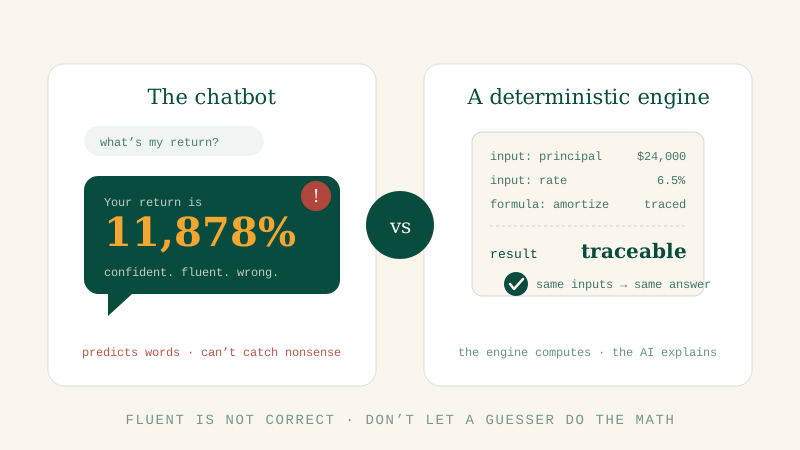
The answers were, in his words, “grammatically correct and seemingly authoritative.” They were also, in several cases, wrong. Asked to compare loans, all three models recommended a 9% one-year loan over a 1% ten-year loan, ignoring the time value of money and steering the borrower toward paying moreinterest. Asked about a life-insurance policy, one model reported a “return” of 11,878% by dividing a $1 million death benefit by the annual premium, as if the buyer would pay one premium and die on schedule. Another computed a negative 530% first-year return on a home purchase through garbled expense accounting.
Smith's conclusion is the sentence worth remembering: the models “do not have the common sense needed to recognize when their answers are obviously wrong.” A person who computed an 11,878% return would stop and say “that can't be right.” The model doesn't, because it isn't checking a number. It's producing a sentence.
And in 2026, the same question still gets different answers
You might expect newer models to have closed the gap. A June 2026 study in the same journal, by researchers at the University of Georgia and the University of Rome Tor Vergata, tested seven current chatbots (ChatGPT, Claude, Copilot, DeepSeek, Gemini, Meta AI, and Perplexity) on the same handful of everyday scenarios.
The headline finding wasn't that the answers were always wrong. It was that they were inconsistent. For one identical emergency-savings scenario, the recommended amount ranged from about $19,500 to $37,500 depending on which chatbot you asked. For one 30-year-old couple with $300,000 to invest, suggested stock allocations ran from 15% to 40%. Same numbers, same question, wildly different advice. And when the researchers changed only the hypothetical person's race or gender and left the finances untouched, the recommendations shifted again, which is its own kind of problem.
The authors' warning is blunt: these responses “may sound confident but can still be incomplete, misleading or incorrect.” They also point out something structural that's easy to miss: a chatbot has no fiduciary duty. A licensed advisor is legally bound to act in your interest. A language model is bound to nothing. It owes you a fluent paragraph, not a correct one.
Why language models get money wrong
None of this means the models are “bad.” It means they are being asked to do a job they were never built for. A large language model predicts the next word in a sequence. It is astonishingly good at that, good enough that the output reads like reasoning. But when the question is “what does this loan actually cost over fifteen years,” predicting a plausible-sounding number is not the same as running the amortization schedule and checking it.
Two failure modes fall out of this. First, the model can produce a number that is confidently, specifically wrong, and phrase it exactly like a right one. Second, because it's sampling from a distribution of likely text rather than computing a single correct result, you can ask the same question twice and get two different answers, which is exactly what the 2026 study documented. Neither failure announces itself. That's what makes them dangerous: the wrong answer looks identical to the right one.
The fix isn't a smarter chatbot
The instinct is to wait for the next, smarter model to fix this. That misreads the problem. The issue isn't that the model isn't smart enough; it's that a word-predictor is the wrong tool to be in charge of the arithmetic. You don't fix it by making the predictor bigger. You fix it by not asking it to compute in the first place.
The architecture that actually works is a division of labor: a deterministic engine does the math, the same inputs always produce the same, auditable output, and the AI reads what you tell it and explainswhat the engine computed, in plain language. That's the principle InvestEd is built on, and it's why we check the numbers in the AI's replies against the engine. We wrote out exactly how that boundary works on our Responsible AI page.
It's the same reasoning behind our companion piece on whether to pay off debt or invest, a decision that hinges on a precise figure over many years, and therefore one you want computed, not guessed.
What to ask before you trust any AI money answer
You don't need to abandon AI for money questions. You need to know what it's good at, explaining concepts, laying out options, summarizing, and where to stop trusting it. Five questions worth asking of any AI answer that involves a number:
1. Did it compute this, or generate it? If the number came out of a chat response with no engine or formula behind it, treat it as a plausible guess, not a result.
2. Can I see the math?A trustworthy answer traces back to the inputs and the formula. If you can't follow how it got there, you can't catch it when it's wrong.
3. Does it change if I ask again? If the same question yields a different number the second time, the tool is sampling text, not calculating.
4. Does it pass a sanity check?An 11,878% return or a negative-530% first year should trip an alarm. If the tool doesn't flag its own nonsense, you have to.
5. What are the assumptions? Most money answers depend on an assumed rate of return or timeline. A good answer shows you those and how sensitive the result is to them. A confident single number that hides its assumptions is the failure mode, not the feature.
Run it on your own numbers
The studies above used hypothetical people. Your situation is specific (your loan, your rate, your timeline, your goal), and that is exactly the kind of question where a guessed number is worst. The InvestEd Wealth Planner computes the month-by-month outcome of your plan on a deterministic engine and explains it in plain language, and you can start a scenario in about two minutes, no account linking, no card. Every number traces back to an input you supplied, so you can see why the answer is what it is, and check it.
The bottom line
Can you trust AI with your money? Trust it to explain, to teach, to lay out the trade-offs. That's what it's genuinely good at. Don't trust it to be the calculator. Two peer-reviewed studies, two years apart, reached the same verdict: the answers sound authoritative and are sometimes wrong, and the model can't tell the difference. The fix isn't to stop using AI. It's to make sure the math comes from something that can't make it up.
FAQ
Is ChatGPT good for financial advice?
It's useful for explaining concepts and laying out options, but research published in the Journal of Financial Planning (2024 and 2026) found leading chatbots make arithmetic and reasoning errors and give inconsistent answers to the same question, while sounding confident throughout. Use it to understand a decision, not to compute one.
Why do AI chatbots get financial math wrong?
A language model predicts likely text; it doesn't run a calculation and check it. So it can produce a number that sounds right but isn't, and it lacks the common sense to notice when an answer is obviously off, like reporting a return in the thousands of percent.
How is InvestEd different?
InvestEd separates the two jobs: a deterministic engine does the math, and the AI reads what you tell it and explains what the engine computed. We check the numbers in its replies against the engine. It's education-first: it shows you the framework and the math, and the decision stays yours.
Sources
Gary N. Smith, “LLMs Can't Be Trusted for Financial Advice” , Journal of Financial Planning, May 2024.
Swarn Chatterjee, Brenda Cude & Gianni Nicolini (University of Georgia and University of Rome Tor Vergata), study on AI chatbots and financial advice, Journal of Financial Planning, June 2026.
First National Bank of Omaha, 2025 Financial Wellbeing Study, September 2025.
Vignesh Coumarane is the founder and product architect of InvestEd. A data analytics professional and LinkedIn Top Voice for data, he writes about the architecture of trustworthy financial tools, including AI Financial Guidance: 4 Hard Truths Apps Ignore on Fintechbits.