

InvestEd February 13, 2026
Financial concepts aren't inherently complicated. The problem is how they're delivered: too early, too abstract, and too disconnected from the choices people actually face.
A good system should do three things: explain the why in plain language, show the impact of decisions with scenarios, and remember what changed so future guidance stays consistent.
The gap is real (and measurable)
Why traditional financial education fails
Four patterns repeat across most of what passes for financial education today. None of them are malicious; all of them leave the person who needed help stuck in the same place.
Too academic
University courses teach theory — efficient markets, CAPM, portfolio math — but rarely translate into the actual choice between a Roth and a traditional IRA. The knowledge exists; it's trapped in a format that doesn't serve real people making real decisions.
Too generic
Most financial content offers one-size-fits-all advice. “Max out your 401(k)” is sound guidance, but meaningless to someone drowning in student debt with no employer match. Generic advice ignores the very thing that matters most: your specific situation.
Too expensive
Quality financial advice has historically been gatekept by cost. Certified planners charge by the hour; many wealth firms require minimums. The people who need guidance the most — early-career workers, first-generation investors, people climbing out of debt — are precisely the ones priced out.
Too late
Financial education typically arrives at the wrong moment: a high-school class years before you need it, or a panicked Google search the night before a big decision. The gap between learning and doing is enormous. By the time most people seek the knowledge, the window for the best action has often passed.
How AI changes the shape of help
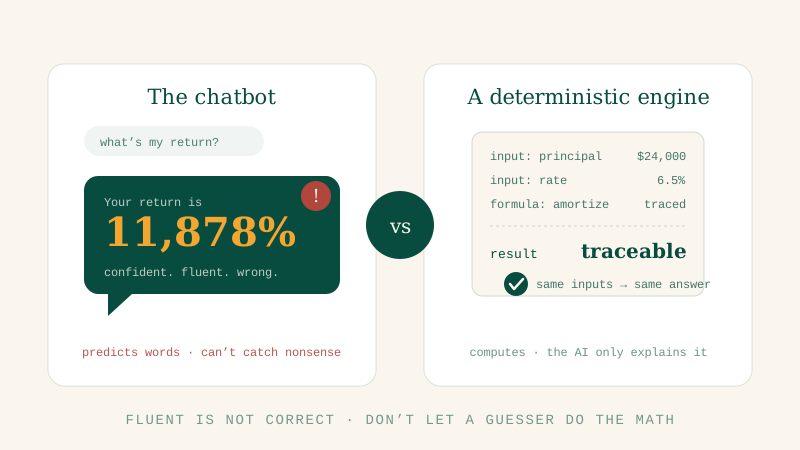
The promise of AI in personal finance isn't a smarter chatbot. A language model can be confident and fluent and still hand back a wrong number. The promise is that math becomes the source of truth and the AI's job is to explain the result — never to invent it.
That changes what a financial tool can do. It can meet you at decision-time, in plain language, with numbers that trace back to a formula and an input you supplied.
Scenario simulation and stress tests
What happens to your plan if inflation stays high? What if you lose your job for six months? What if you increase contributions by $200 a month?
InvestEd runs scenarios against your inputs — not hypothetical averages — so you can see the impact before you commit.
Personalized, step-by-step learning
You don't need every concept at once. You need the next right thing: the trade-off and the decision in front of you.
InvestEd explains the “why” in plain language, then ties it directly to your plan — so learning becomes action.
Contextual, bias-free guidance
Unlike banks that profit from your confusion or finfluencers pushing affiliate products, InvestEd has no product to sell. It exists to make you smarter.
Guidance stays grounded in your goals, constraints, and timeline — not incentives.
A companion that remembers
Life doesn't wait for your annual financial review. Raises, emergencies, home buying, career moves — they need guidance now, not next quarter.
InvestEd remembers what changed and keeps your guidance consistent as you iterate.
What “fixed” looks like
A fixed system isn't one that gives more advice. It's one that makes the math visible, keeps the person in the decision, and stays consistent as life changes. The bar isn't whether the tool sounds smart; it's whether the person walks away knowing what their numbers say and why.
That's the philosophy behind the InvestEd Wealth Planner: you enter your situation, the engine computes the outcome, and the AI explains the result — never invents it. Read more on our AI principles, or start a scenario in two minutes.
FAQ
Does InvestEd give financial advice?
No. It runs the math on your inputs and explains the outcome. You make the decision.
How is this different from a chatbot?
A chatbot generates text. InvestEd's engine generates the numbers, and the AI explains them. The math is the source of truth.
Do I need to link my bank?
No. InvestEd doesn't ask for credentials. You enter the inputs that matter for your scenario, and the tool does the rest. See our privacy architecture for the full picture.
Comments
Loading comments…