

Vignesh July 28, 2026
Earlier this month I measured whether four AI assistants agree on the same money question. Often they do not — that was the Drift Index. But there is an earlier, quieter drift underneath the answer, and nobody is measuring it: the interview.
Three windows, three interviews
Open three fresh windows of the same assistant and ask the same thing — “should I pay down my mortgage or invest the difference?” In one it asks your rate and your horizon. In another it assumes a rate and goes straight to a recommendation. In a third it asks about your emergency fund but never your tax bracket. Three interviews, three sets of assumptions, three plans. Same person, same question, same minute.
Output drift you can at least see— two different final numbers sitting next to each other. Intake drift you cannot. You do not know what it did not ask, so you cannot tell you got a different interview from the one your neighbor got. The variance moved upstream, where it is invisible.
Why the skipped question is the expensive one
The questions an assistant drops are rarely the harmless ones. It will not reliably ask what happens to your car payment once that loan clears — the freed $520 a month has to go somewhere, and where it goes changes the answer. That is not really an input; it is a modelling decision, and the model makes it silently. Two paths it presents as a fair comparison can quietly end up not spending the same money.
Try it: three windows, and write down the questions each one asked you. The lists will not match. That is the whole point — and it is checkable in ten minutes.
This is fixable, and it keeps the AI
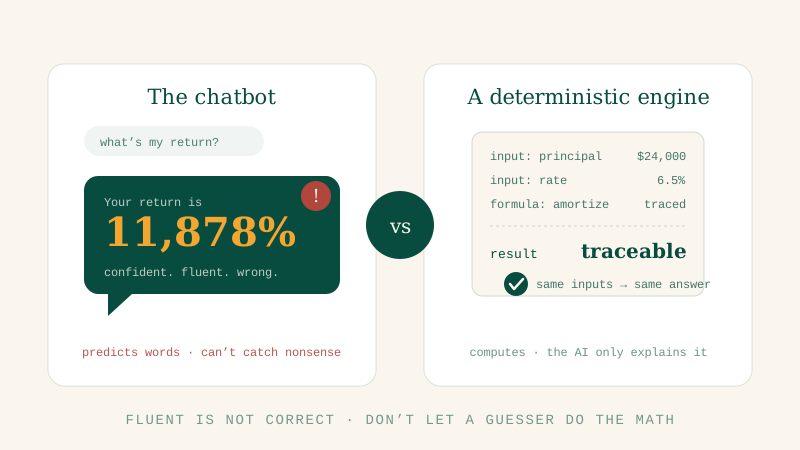
None of this is an argument against AI. It is an argument for a fixed interview — the same slots asked every time — feeding an engine that computes the number the same way for everyone. Pin the interview and the computation, and the assistant is free to do the thing it is best at: explain what the result means, in plain language, for you. That is how InvestEdruns — the same interview every time, and it shows its work.
This piece measures how the tools ask, not what you should do. It makes no recommendation.